Arkansas construction projects generate thousands of tons of debris each year, from concrete and lumber to drywall and metals. The challenge for contractors and builders is not just removing this waste but doing so in a way that reduces landfill burden and often lowers project costs. Construction waste diversion strategies Arkansas have evolved rapidly as state regulations tighten and as more project owners demand sustainable practices. Understanding how to separate, recycle, and repurpose materials on a jobsite can save money, improve compliance, and strengthen a company’s reputation.
Waste diversion is the practice of redirecting materials away from landfills through recycling, reuse, or donation. In Arkansas, the push for diversion comes from both environmental goals and economic incentives. Landfill tipping fees continue to rise, and hauling mixed debris costs more than transporting source-separated recyclables. For a typical 2,000-square-foot home renovation, as much as 80 percent of the waste can be diverted with the right plan. That means fewer dumpster hauls, lower disposal costs, and a smaller environmental footprint.
Why Diversion Matters for Arkansas Contractors
Arkansas does not yet have a statewide mandatory construction waste diversion law, but several municipalities have adopted green building ordinances that require recycling plans for permits. Little Rock and Fayetteville, for example, encourage or mandate waste reduction in commercial projects. Beyond compliance, contractors who adopt diversion strategies gain a competitive edge when bidding on public projects or corporate contracts that require sustainability reporting.
Financial savings also drive adoption. Mixed waste dumpster rentals in Arkansas often cost more per ton than segregated recycling containers. When a contractor separates clean wood, metal, and cardboard, those materials can be sold to recyclers or disposed of at lower rates. The savings add up quickly on large-scale projects. In our guide on choosing the right construction waste dumpster for your project, we explain how container size and material segregation affect overall project costs.
The Core Components of a Diversion Plan
A successful diversion strategy starts before the first hammer swings. The planning phase determines which materials will be generated and how each stream will be handled. Contractors should evaluate the project scope, identify recyclable materials, and arrange for separate containers or collection services. The following steps form the backbone of any effective plan:
- Pre-demolition audit: Walk through the structure to identify reusable fixtures, doors, windows, and lumber. Salvage these before demolition begins.
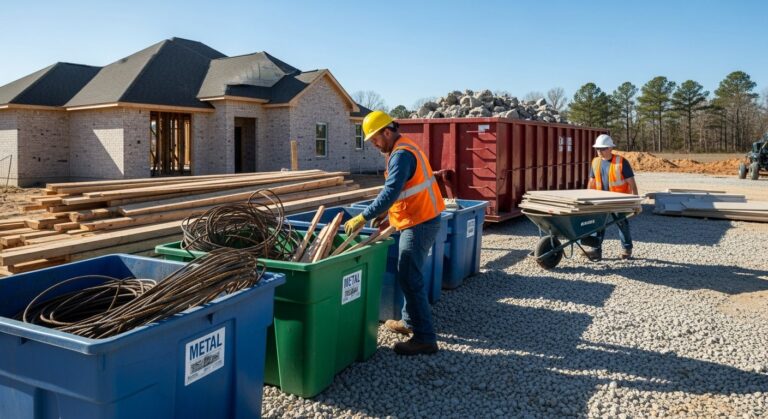
- Source separation: Use dedicated bins or dumpsters for wood, metal, concrete, cardboard, and gypsum. This keeps clean streams uncontaminated and maximizes recycling value.
- Partner with recyclers: Establish relationships with local facilities that accept construction materials. Many Arkansas recyclers offer competitive pricing for clean loads.
- Train crews: Educate workers on what goes where. Simple signage and regular toolbox talks prevent contamination that ruins a whole load.
These steps are not complicated, but they require discipline. A crew that throws a few pieces of treated lumber into a clean wood bin can render the entire load non-recyclable. That is why training and supervision are as important as the bins themselves.
Material-Specific Diversion Approaches
Concrete and Masonry
Concrete is the heaviest component of most construction and demolition waste. In Arkansas, concrete can be crushed and reused as aggregate for road base, fill, or new concrete. Many demolition contractors bring mobile crushers to large sites, processing material on location. For smaller jobs, concrete can be taken to transfer stations that accept clean rubble. The key is to keep it free of rebar, wood, and trash. Some facilities charge lower fees for clean concrete loads, so separation pays off.
Wood and Lumber
Clean dimensional lumber can be reused directly in new construction or donated to organizations like Habitat for Humanity ReStores. Treated wood, plywood, and engineered wood products cannot be recycled as easily, but they can be chipped for biomass fuel or used as landfill cover. Contractors should separate clean wood from painted or treated wood to maximize diversion rates. Some Arkansas recycling centers accept clean wood pallets and lumber for grinding into mulch or animal bedding.
Metals
Steel studs, copper wiring, aluminum siding, and rebar are all highly recyclable. Metal prices fluctuate, but scrap yards in Arkansas pay competitive rates for sorted ferrous and non-ferrous metals. Setting aside a small roll-off container or a designated area for metal collection can generate revenue that offsets other disposal costs. Many contractors find that metal recycling alone covers the expense of additional bins on site.
Drywall (Gypsum)
Drywall is one of the most challenging materials to divert because it is bulky and can release hydrogen sulfide gas in landfills. In Arkansas, some facilities accept clean gypsum for recycling into new drywall or agricultural soil amendment. The challenge is keeping drywall free of paint, joint compound, and tape. Source separation is essential. When drywall is mixed with other debris, it almost always goes to landfill.
Donation and Reuse Opportunities
Not all construction waste needs to be recycled or landfilled. Usable materials such as cabinets, doors, windows, lighting fixtures, and plumbing hardware can be donated to nonprofit organizations. In Arkansas, Habitat for Humanity ReStores accept new and gently used building materials and sell them to the public at reduced prices. Donations can qualify for tax deductions, and the contractor avoids disposal fees altogether.
Online platforms like Craigslist, Facebook Marketplace, and local reuse networks also connect contractors with homeowners or small builders who want salvaged materials. A simple post offering free clean fill dirt or leftover tile can divert tons of material in a single day. The key is planning ahead so that reusable items are removed before demolition begins and stored in a protected area.
Regulatory Landscape in Arkansas
Arkansas Department of Environmental Quality (ADEQ) oversees solid waste management, including construction and demolition debris. While there is no statewide recycling mandate, ADEQ encourages diversion through its recycling grants and technical assistance programs. Some counties and cities have adopted their own rules. For example, Fayetteville requires all commercial construction projects over a certain size to submit a waste management plan that includes recycling targets.
Contractors working on state-funded projects should also check for specific requirements. The Arkansas Division of Building Authority often includes diversion goals in its bid specifications. Staying ahead of these requirements can streamline permitting and reduce the risk of fines. As more municipalities consider ordinances similar to those in Fayetteville, proactive contractors will have an advantage.
Measuring and Reporting Diversion Rates
To demonstrate compliance or earn green building certification, contractors need accurate data on waste diversion. The standard metric is the diversion rate: the weight or volume of materials diverted divided by the total waste generated. Tracking this requires weigh tickets from landfills and recyclers, as well as estimates for donated materials. Many contractors use simple spreadsheets to log each load and calculate the percentage diverted.
For projects pursuing LEED certification, the U.S. Green Building Council requires documentation of diversion rates. A typical target is 50 to 75 percent diversion of construction and demolition waste. Achieving these levels in Arkansas is feasible with careful planning and the right partners. Some contractors find that partnering with a waste management consultant helps them navigate reporting requirements and identify new diversion opportunities.
Common Challenges and Solutions
Even the best diversion plans face obstacles. Contamination is the most frequent problem: one contaminated load can ruin an entire recycling stream. The solution is clear labeling, crew training, and regular bin inspections. Another challenge is the cost of additional bins. While separate containers for wood, metal, and concrete increase upfront rental fees, the savings from lower disposal costs and potential recycling revenue often offset the expense.
Space constraints on tight urban jobsites can also make source separation difficult. In these cases, contractors can use smaller bins or schedule more frequent pickups. Some Arkansas waste haulers offer compactors that reduce the volume of mixed waste, lowering hauling frequency. Another option is to use a single bin for mixed waste and sort it at a materials recovery facility, though this usually results in lower diversion rates and higher costs.
Material markets also fluctuate. When scrap metal prices drop, the incentive to separate metal declines. Similarly, some recycling facilities may temporarily stop accepting certain materials. Contractors should maintain relationships with multiple end markets to adapt quickly. Diversification is the key to a resilient diversion program.
Case Study: A Little Rock Commercial Project
A mid-sized commercial renovation in Little Rock generated 120 tons of waste over six weeks. The contractor implemented a diversion plan that included separate containers for concrete, metal, clean wood, and drywall. Concrete was crushed on site and reused as fill. Metal was sold to a local scrap yard. Clean wood was chipped for landscaping mulch. Drywall was taken to a facility that processes gypsum for agricultural use.
The result was a diversion rate of 68 percent, well above the 50 percent target. The contractor saved approximately $4,500 in disposal costs compared to a mixed-waste approach. The project also earned recognition from the city for sustainable practices, which helped the contractor win future bids. This example shows that with planning and commitment, diversion is both environmentally responsible and financially smart.
Future Trends in Arkansas Diversion
As landfill capacity diminishes and environmental awareness grows, Arkansas is likely to see more aggressive diversion policies. Extended producer responsibility programs, where manufacturers pay for recycling of their products, could apply to materials like carpet, paint, and roofing. Advances in sorting technology may also make it easier to recover materials from mixed waste streams.
Contractors who invest now in diversion infrastructure and training will be well positioned for these changes. Building relationships with recyclers, learning the local regulatory landscape, and tracking diversion metrics will become standard practice. The construction industry in Arkansas is moving toward a circular economy model, where waste is seen as a resource rather than a liability.
Adopting construction waste diversion strategies Arkansas today is not just about compliance or cost savings. It is about building a business that is resilient, competitive, and aligned with the values of clients and communities. Every ton diverted from the landfill is a step toward a more sustainable construction industry in the Natural State.