
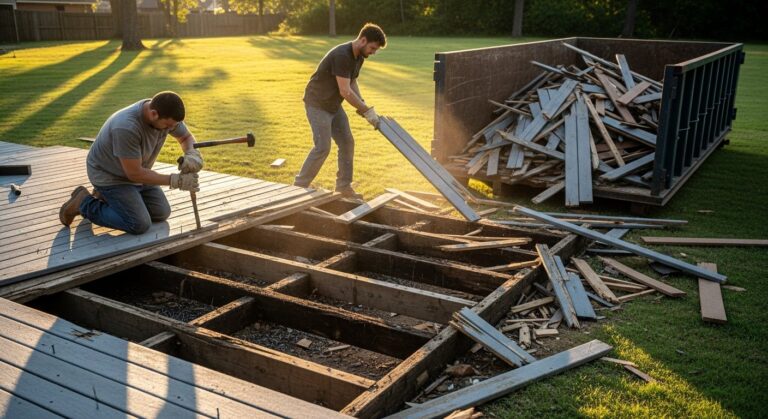
A deck can be one of the most enjoyable parts of a home, but when the boards start to rot, the railings wobble, or the structure no longer meets safety standards, it is time for demolition. The problem is not tearing the deck apart; it is what to do with the resulting pile of old wood and composite boards. Deck demolition waste disposal requires planning, and this guide explains the best paths for any homeowner or contractor in Arkansas. From sorting materials to choosing a dumpster rental, you will learn how to handle every part of the debris stream without violating local rules or wasting money.
Understand What You Are Dealing With: Wood and Composite
Old decks are built from a surprising variety of materials. Many homeowners assume that all deck waste is the same, but the disposal rules and recycling opportunities differ significantly between pressure treated lumber, cedar, redwood, and composite decking. Before you call a waste removal service, you need to identify what is in your pile.
Pressure treated wood is the most common deck framing and decking material. It contains chemical preservatives that protect against rot and insects. These chemicals, usually chromated copper arsenate or alkaline copper quaternary, make treated lumber unsuitable for burning or use as mulch. Many landfills accept treated wood, but some jurisdictions require separate handling. Untreated wood, like cedar or redwood, is easier to recycle or repurpose. Composite decking, which combines wood fibers with plastic binders, is heavier and often contains additives that make recycling difficult. Some composite brands have take back programs, but most municipal recyclers will not accept it.
Understanding these distinctions matters because it changes your disposal strategy. Clean untreated wood can go to a wood recycling center, while treated wood and composite boards typically end up in a landfill. When you know the composition of your deck, you can plan the right dumpster size and avoid surprises at the landfill gate.
Estimate the Volume and Weight of Your Deck Waste
One of the biggest mistakes in any demolition project is underestimating the amount of debris. A deck that looks small when attached to your home suddenly becomes a massive pile of joists, spindles, beams, and fasteners once it is torn down. To choose the right disposal method, you need a rough estimate of the cubic footage and weight.
Start by measuring the deck footprint. Multiply the length by the width to get the square footage. That number only covers the deck boards. You also need to account for the framing, railings, stairs, footings, and any built in benches or planters. A simple calculation is to multiply the square footage by 0.5 to 0.75 to get the volume in cubic yards. For example, a 200 square foot deck might produce 100 to 150 cubic feet of waste, or roughly 4 to 6 cubic yards.
- Decking boards: the top surface, which is usually cedar, pine, or composite.
- Joists and beams: the structural frame beneath the decking.
- Railings and balusters: often a mix of wood and metal or composite.
- Stairs and stringers: bulky pieces that take up a lot of dumpster space.
- Posts, piers, and concrete footings: these are very heavy and may need separate handling.
Weight is even harder to guess. Dry treated lumber weighs about 50 to 75 pounds per cubic foot, while wet or green wood can be much heavier. Composite decking is denser, often exceeding 100 pounds per cubic foot. When you factor in nails, screws, and metal connectors, the total weight can easily push a small dumpster to its limit. This is why you should always discuss the specific materials with your dumpster rental provider.
Disposal Options for Old Deck Wood and Composite
Depending on where you live in Arkansas, you have several ways to dispose of deck demolition waste. The most straightforward option is to toss everything into a residential dumpster and let a local hauling company take it to a landfill or transfer station. But there are other routes worth considering, especially if you want to reduce your environmental footprint or save money on tipping fees.
Curbside bulky item pickup is rarely suitable for a full deck demolition. Most municipal programs limit what they take, and they usually reject construction debris. A single pile of old deck boards could be collected piece by piece, but that process is slow and unreliable. For a project of this scale, you need a dedicated waste receptacle.
Landfill disposal is the most common final destination. In Arkansas, many landfills accept mixed construction and demolition debris. Treated wood is generally allowed, but you should check with the specific landfill or transfer station about any special requirements. Some landfills charge extra for loads that contain pressure treated wood, so it is worth asking about fees before you book a dumpster.
Recycling and reuse are better options for clean wood. You can list reusable boards on local marketplace sites or donate them to a habitat restoration organization. Untreated wood can be chipped into mulch or used for firewood, though you should never burn treated wood because the smoke and ash are toxic. For composite materials, recycling options are rare. A few composite manufacturers operate take back programs, but the logistics are often difficult for a small demolition project.
The most practical solution for most homeowners is a dumpster rental. A dumpster sits on your property, you throw all the debris in, and the hauling company handles the rest. This method protects your vehicle from hauling wear, keeps the site tidy, and ensures that waste is disposed of according to local regulations. It also gives you the flexibility to work at your own pace.
- Pros: one container holds all debris, no need to load a truck, ideal for large projects.
- Cons: rental fee, requires driveway or yard space, cannot mix prohibited items.
When you compare disposal options, think about the total cost of your labor, fuel, and time. Driving away from a box truck or trailer can be exhausting, and every trip to the landfill adds mileage and disposal fees. A dumpster rental often becomes the most economical choice for any deck larger than a few hundred square feet.
How to Prepare Your Deck Waste for Removal
Preparation makes the difference between a smooth demolition and a frustrating one. Before you start swinging a pry bar, take a few steps to organize the work area. This is especially important if you are using a dumpster, because a well prepared pile loads faster and prevents dangerous overhangs.
First, remove all fasteners that can puncture tires, tear gloves, or injure someone who handles the boards. Nails and screws should be pulled or hammered flat. For composite materials, note that the boards are often attached with hidden clips that can be reused, but those clips also need to be separated if you plan to recycle.
Second, separate the materials into categories. Put treated wood in one pile, clean wood in another, and composite boards in a third. This separation makes it easy to see whether you can recycle certain pieces and also makes it easier for dumpster workers to distribute weight evenly. You should also set aside any non wood components, like metal railing sections, glass, or plastic, because those may have different disposal rules.
Here is a simple process to follow:
- Clear the deck of furniture, planters, and accessories.
- Remove decking boards first, starting from the outer edge and working inward.
- Take off railings and banisters, cutting them into manageable lengths if necessary.
- Remove joists and beams, using a reciprocating saw or crowbar.
- Break up concrete footings and separate them from the rest of the debris.
As you work, keep the piles neat and compact. Long boards can be cut down to 4 to 6 foot sections to make them easier to lift and to prevent waste of space in the dumpster. Stacking treated lumber flat and composite boards separately will also help you estimate how much room you have left.
Choose the Right Dumpster Size for Deck Demolition
Dumpster rentals come in a range of sizes, from small 10 yard containers to large 40 yard roll offs. For a typical residential deck, you will likely need a 15, 20, or 30 yard dumpster. The right size depends on the deck footprint, the framing density, and how much of the material is composite versus wood.
A 10 yard dumpster is usually too small for a complete deck demolition. It can handle one or two sections, but once you start removing joists and beams, the volume adds up quickly. A 15 yard dumpster is a good starting point for a small deck, around 100 to 150 square feet. For a medium deck, 200 to 300 square feet, a 20 yard dumpster is safer. If you have a two story deck, a patio cover, or extensive composite decking, consider a 30 yard unit.
Weight is a critical factor in dumpster selection. Composite boards are denser than wood, and older decks may be wet or filled with heavy fasteners. Even if the volume fits in a smaller dumpster, the weight may exceed the safety limit. Your dumpster rental provider can help you estimate, but it never hurts to be conservative.
If you are also planning to remove a shed or garage on the same property, you can follow the detailed process in our Arkansas shed garage demolition waste disposal step by step guide, which covers many of the same principles and helps you coordinate multiple projects.
Work with an Arkansas Dumpster Rental Service
Choosing a local dumpster rental service has distinct benefits. A company that operates in your area understands the local landfill regulations, knows which materials are acceptable, and can schedule delivery and pickup quickly. For residents of Arkansas, that means fewer surprises and faster service.
When you book a dumpster, the company usually delivers it to your driveway or job site. You then have a specific rental period, often 5 to 7 days, to fill it. The driver places the dumpster on a flat surface, and you are responsible for not exceeding the fill line. On pickup day, the driver hauls it away and disposes of the contents at a permitted facility.
Ask about placement. Dumpsters need about 14 to 15 feet of overhead clearance and a stable surface. If you have a narrow driveway or a low hanging tree, the delivery driver may need to position the dumpster elsewhere. Some cities in Arkansas require permits for dumpsters placed on the street, but a local service can guide you through that process or include the permit cost in your quote.
A reputable company will also answer questions about prohibited items. Paint, solvents, tires, and batteries should never go in a roll off dumpster. By keeping your deck waste to wood, composite, nails, and concrete, you stay compliant and avoid extra fees.
Cost Control and Avoiding Surprises
Deck demolition budgets are easy to exceed if you do not plan for disposal costs. Dumpster rental prices vary based on size, weight, rental period, and local tipping fees. A low quote may not include additional charges for overweight loads, extra days, or prohibited materials.
Always request a written quote that details what is included. Ask about the weight limit and the overage rate per ton. For a deck project, the weight can quickly add up, so it is wise to reserve a slightly larger dumpster than you think you need. Paying for a 20 yard dumpster is often cheaper than paying overage fees on a 15 yard container.
You can also reduce costs by doing your own prep work. Cutting boards into manageable sizes and removing nails from large components can help you pack more material into each cubic yard. If you are working with a contractor, ask them to sort clean wood separately so you can take it to a recycling center and save landfill space.
Finally, consider the value of your old deck materials. Some salvage companies buy redwood or cedar decking that is still in good shape. Composite boards with a long history can sometimes be donated to a school or community center for reuse. Even if these options only reduce your waste volume by a small amount, they lower disposal costs and keep usable materials out of the landfill.
Deck demolition waste disposal does not have to be a headache. By understanding the materials, estimating volume, preparing the debris, and working with a dependable dumpster rental company in Arkansas, you can clear your property quickly and safely. The key is to plan before you demolish, and to use the right container for the job.