After an asbestos inspection confirms the presence of hazardous materials on your Arkansas property, the next steps can feel overwhelming. Proper disposal is not just a matter of convenience; it is a legal requirement designed to protect public health and the environment. Understanding Arkansas asbestos disposal regulations after inspection is critical for homeowners, contractors, and property managers who must handle and remove these dangerous fibers safely. Failure to comply with state and federal rules can result in significant fines, legal liability, and serious health risks for workers and nearby residents.
The Arkansas Department of Environmental Quality (ADEQ) enforces strict guidelines for asbestos-containing materials (ACM). These regulations align with the federal National Emission Standards for Hazardous Air Pollutants (NESHAP) but include specific state-level requirements for notification, transportation, and landfill disposal. Once an inspection confirms the presence of asbestos, you cannot simply bag the material and place it with regular trash. Instead, you must follow a detailed protocol that begins with proper wetting and sealing of the waste, continues with labeled transport, and ends at an approved disposal facility. This article walks you through each phase so you can manage your project with confidence and avoid costly mistakes.
What the Inspection Report Triggers
An accredited asbestos inspector will collect samples from suspect materials such as floor tiles, pipe insulation, roofing shingles, and siding. The samples are analyzed using polarized light microscopy (PLM) to determine the percentage and type of asbestos present. If the lab report confirms greater than one percent asbestos, the material is regulated ACM. This finding triggers a set of mandatory actions under Arkansas Regulation 21 and the federal NESHAP. You must notify ADEQ before beginning any renovation or demolition activity that will disturb the asbestos. The notification window is typically 10 working days before the start of work, though emergency situations have different deadlines.
Once you have the inspection results, the next critical step is selecting a licensed asbestos abatement contractor. Arkansas requires that all persons performing asbestos abatement hold a valid license issued by ADEQ. This includes supervisors, workers, and the contracting company itself. Hiring a licensed contractor ensures that the removal, packaging, loading, and transportation of the waste will follow the law. It also protects you legally because the contractor takes responsibility for proper disposal and documentation. You should request proof of licensing, insurance, and a copy of their ADEQ waste shipment record before work begins.
Packaging and Labeling Requirements for Asbestos Waste
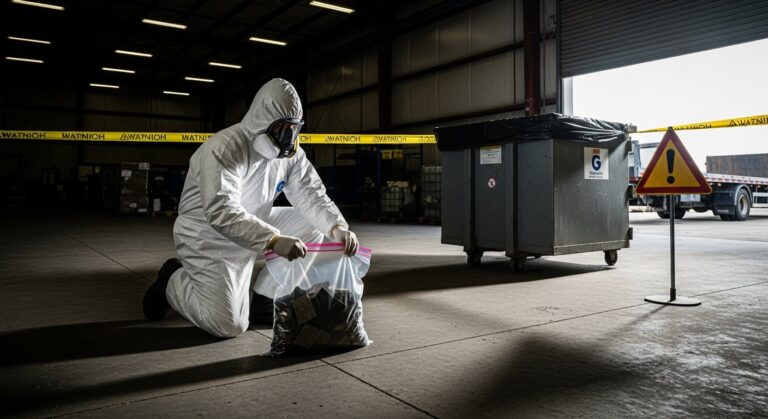
The regulations specify exactly how asbestos waste must be contained. The material must be wetted thoroughly with a mixture of water and a surfactant to suppress dust. It must then be sealed in two layers of six-mil-thick polyethylene bags or sheeting. Each layer must be sealed with tape or by twisting and tying the material securely. The outer bag must display a warning label that meets OSHA and EPA standards. The label must include the word “Asbestos” in large letters, a warning about cancer and lung disease, and instructions to avoid creating dust. Bags that are not labeled properly can be rejected at the landfill, forcing you to repackage the waste at additional cost.
Large debris such as pipes, wallboard, or roofing material may be placed in lined, leak-tight containers or wrapped in two layers of plastic sheeting. The containers must also be labeled. If you are using a roll-off dumpster for the project, the dumpster itself must be lined with plastic sheeting, and the waste must be placed inside in sealed bags or wrapped sections. The dumpster must be covered with a tarp or lid during transport to prevent any material from escaping. These containment measures are not optional; they are enforceable requirements under ADEQ rules.
Transportation and Manifest Requirements
Transporting asbestos waste in Arkansas requires a waste shipment record, also known as a manifest. This document tracks the waste from the generation site to the final disposal location. The manifest includes the generator’s name and address, the waste volume or weight, the transporter’s name and license number, and the disposal facility’s name and address. The driver must carry the manifest in the vehicle at all times. Copies of the manifest must be kept by the generator, the transporter, and the landfill for at least two years. Arkansas law requires that the vehicle used for transport be covered and that the asbestos waste be secured to prevent any release.
Only vehicles that are properly licensed and operated by a certified transporter may carry asbestos waste. You cannot haul asbestos in your personal pickup truck unless you hold the appropriate certifications. Most property owners hire the abatement contractor to handle all transportation because the contractor already holds the necessary permits. If you choose to self-transport, you must first obtain a transporter license from ADEQ and comply with all packaging, labeling, and manifest requirements. The penalties for transporting asbestos without proper documentation include fines of up to $25,000 per day per violation.
Approved Disposal Facilities in Arkansas
Asbestos waste can only be disposed of at landfills that are specifically permitted to accept it. Not every landfill in Arkansas is authorized to handle ACM. The ADEQ maintains a list of approved asbestos disposal facilities, which currently includes the St. Francis County Landfill in Forrest City, the Pine Bluff Landfill in Jefferson County, and the BFI Subtitle D Landfill in Little Rock, among others. You must contact the landfill in advance to confirm that they have capacity and to obtain any specific requirements they may have for delivery. Landfills often require that the waste be delivered in a separate load from other construction debris to prevent cross-contamination.
When you arrive at the landfill, the facility will inspect the waste and the manifest. They will verify that the bags or containers are properly labeled and sealed. If any bags are torn, leaking, or unlabeled, the landfill may refuse the load. In that case, you must take the waste to a different approved facility or repackage it on-site before disposal. The landfill will then bury the waste in a dedicated cell or trench and cover it immediately with at least six inches of soil. The disposal fee for asbestos is typically higher than for general construction waste because of the additional handling and recordkeeping requirements. Expect to pay between $50 and $150 per ton, depending on the facility and the volume of waste.
Recordkeeping and Documentation
Proper documentation is a cornerstone of Arkansas asbestos disposal regulations after inspection. You must retain all records related to the inspection, abatement, transportation, and disposal for at least three years. This includes the original inspection report, the waste shipment records, the landfill receipts, and any air monitoring results if you conducted clearance testing. These records prove that you complied with the law and can protect you in the event of an audit or a future property transaction. If you sell the property, the buyer or their lender may request these documents as part of the due diligence process.
ADEQ has the authority to conduct inspections of your records at any time. They may also inspect the property after abatement to verify that no visible residue remains. If you cannot produce the required documents, you may be subject to penalties. In our guide on Asbestos Inspection Demolition Arkansas Regulation 21 Compliance, we explain how to maintain a complete paper trail that meets state requirements. Keeping digital copies of all documents in a secure location is a best practice that many property owners overlook.
Common Violations and How to Avoid Them
Even experienced contractors sometimes make mistakes that lead to violations. The most common errors include failing to wet the asbestos adequately before removal, using single-layer bags instead of double-layer bags, and neglecting to label containers. Another frequent violation is transporting asbestos without a completed manifest or using an unapproved landfill. Homeowners who attempt to save money by doing the work themselves often commit these violations because they are unaware of the specific rules. The result is a fine that far exceeds the cost of hiring a licensed professional.
To avoid these pitfalls, follow this checklist before starting any asbestos project:
- Obtain a written inspection report from a licensed inspector before any demolition or renovation.
- Hire a licensed abatement contractor who carries workers’ compensation and liability insurance.
- Ensure the contractor submits a 10-day notification to ADEQ before starting work.
- Confirm that the disposal facility is on the ADEQ approved list and has confirmed acceptance of your waste.
- Request copies of all manifests and landfill receipts before the contractor leaves the site.
Following this checklist reduces your risk of noncompliance and ensures that your project runs smoothly. If you are unsure about any step, consult with ADEQ directly or work with a waste management company that specializes in asbestos disposal. Many dumpster rental companies in Arkansas can coordinate the entire process, including the disposal at an approved facility, saving you time and worry.
Cost Considerations for Asbestos Disposal
The total cost of asbestos disposal includes inspection fees, abatement labor, transportation, landfill charges, and documentation. Inspection typically costs $400 to $800 for a standard residential property. Abatement labor ranges from $50 to $150 per hour, depending on the complexity of the job and the volume of material. Landfill disposal fees add another $50 to $150 per ton. For a typical home with 500 square feet of asbestos floor tiles, the total cost might fall between $2,000 and $5,000. Commercial projects can cost significantly more, especially if large amounts of pipe insulation or roofing material are involved.
Some property owners consider illegal disposal to avoid these costs. This is a dangerous choice. Dumping asbestos in a regular trash can or an unapproved dumpster is a violation of both state and federal law. The penalties include fines of up to $37,500 per day under the Clean Air Act, plus potential criminal charges. In addition, illegal dumping creates a public health hazard that can affect children, pets, and neighbors. The ethical and legal reasons to comply with Arkansas asbestos disposal regulations after inspection are clear. The cost of compliance is an investment in safety, legal protection, and community responsibility.
Arkansas asbestos disposal regulations after inspection may seem complex, but they exist to prevent a known carcinogen from harming people and the environment. By following the steps outlined in this article, you can navigate the process with confidence. Start with a thorough inspection, hire licensed professionals, package the waste correctly, use approved transporters and landfills, and keep detailed records. If you prioritize compliance at every stage, your project will be safe, legal, and successful.