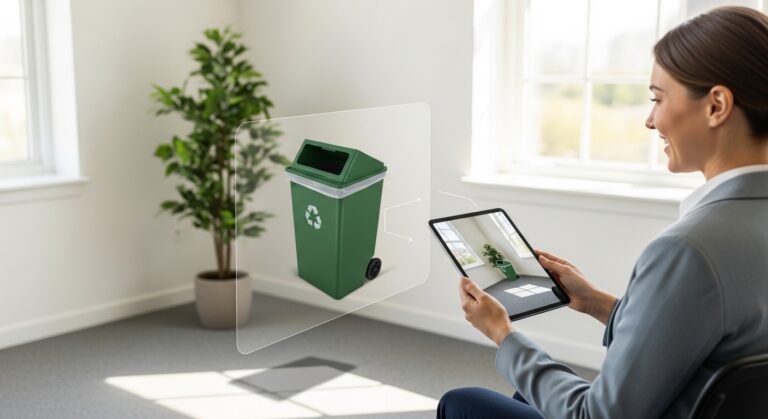
Imagine being able to visualize the perfect waste management setup for your home, business, or construction site before you commit to a single bin or service. This is no longer a futuristic concept but a practical, accessible tool transforming how we approach waste. Augmented reality (AR) for waste bins is emerging as a game-changing technology, allowing users to project digital models of bins, dumpsters, and compactors into their real-world spaces through a smartphone or tablet. This guide explores how this innovative application of AR is revolutionizing waste planning, from simplifying complex disposal regulations to ensuring you choose the right container size for any project, saving time, money, and significant hassle.
The Core Technology Behind Waste Bin AR
At its heart, waste bins AR utilizes the camera and sensors on a modern mobile device to overlay digital 3D models onto a live video feed of your environment. This is more than a simple photo filter; it involves spatial mapping to understand the dimensions of a room, yard, or job site. Advanced applications can account for scale, allowing you to see if a 10-yard dumpster will fit comfortably in your driveway or if a new commercial recycling station will obstruct foot traffic. The technology often integrates with product databases from waste service providers, offering accurate models of specific bin designs, from standard curbside carts to large roll-off containers. This creates a powerful, interactive planning tool that bridges the gap between online research and physical reality.
The user experience is typically intuitive. After accessing an AR feature through a service provider’s app or website, you simply point your device’s camera at the intended location. You can then select from a library of virtual waste containers, place them in the scene, and walk around them. You can check clearances for garbage trucks, assess how a bin’s lid opens in a confined alley, or even visualize how different color-coded bins for recycling, compost, and landfill will look on your property. This hands-on, visual assessment eliminates the guesswork that often leads to ordering a container that’s too small for a renovation project or too large for a tight urban space. For a deeper dive into how this technology is being applied, our article on how AR is reinventing garbage cans provides specific industry examples.
Practical Applications for Homeowners and Professionals
The utility of waste bins AR spans from simple residential queries to complex commercial logistics. For homeowners, it’s a tool for perfecting domestic waste systems. Before purchasing new outdoor bins or redesigning a kitchen, you can test different sizes and configurations to optimize space and workflow. It’s particularly valuable for navigating local recycling rules, as you can visualize where to place multiple bins for sorting without creating clutter. This technology empowers informed decisions that enhance home organization and compliance.
For contractors, property managers, and business owners, the stakes and benefits are even higher. On a construction site, accurately placing a temporary dumpster is critical for workflow efficiency and safety. AR allows a project manager to scout the site beforehand, identifying the optimal spot that is accessible for delivery and pickup while keeping it out of the way of active work areas. This pre-planning prevents costly mid-project relocations. In commercial settings, such as restaurants, hospitals, or office parks, AR can help design centralized waste and recycling stations that meet volume needs, comply with health codes, and encourage proper sorting from staff and the public. The visual proof provided by AR simplifies approvals from stakeholders and building management.
Key Benefits of Using AR for Waste Planning
Adopting AR tools for waste management delivers tangible advantages that go beyond simple visualization. The following benefits highlight why this technology is becoming an essential part of project planning and operational efficiency.
- Precise Sizing and Fit: Eliminates the risk of ordering a dumpster that won’t fit in the allotted space or a bin that is too small for the waste stream, directly impacting cost and project timelines.
- Enhanced Compliance and Education: Helps users understand and adhere to local waste ordinances by visually mapping out separation requirements, potentially reducing contamination and associated fines.
- Improved Aesthetic and Space Planning: Allows stakeholders to see how waste receptacles integrate with the aesthetics and flow of a space, leading to better-designed, more functional environments.
- Risk Reduction: Identifies potential hazards during the planning phase, such as blocked fire exits, impeded pathways, or unsafe placements for collection vehicles.
- Informed Decision-Making: Provides a concrete, shareable visual aid that facilitates clearer communication between homeowners, contractors, clients, and waste service providers.
These benefits collectively contribute to a more streamlined, cost-effective, and sustainable approach to handling waste. By visualizing the end result, all parties can align their expectations and requirements from the outset. This is especially crucial for larger projects where waste management is a significant line item and logistical challenge. The ability to ‘try before you buy’ in a virtual space builds confidence and prevents the all-too-common scenario of a container becoming a frustrating obstacle rather than a helpful resource.
Integrating AR with Local Waste Services and Rules
The true power of waste bins AR is realized when it is connected to real-world data from local service providers and municipalities. Forward-thinking waste management companies are beginning to integrate AR tools directly into their customer portals. This allows a user in a specific service area, like Paragould or Batesville, to not only visualize a standard 96-gallon cart but also see the exact model and color their provider uses, ensuring perfect accuracy. Furthermore, these tools can be programmed with local guidelines, such as placement distances from curbs, obstructions, and specific sorting rules for recycling.
This integration turns AR from a neat gadget into a vital compliance and educational tool. For instance, a resident confused about new recycling rules could use an app to scan their backyard. The AR system could then show them exactly where to place their Arkansas recycling bins for collection, with digital labels indicating what materials go in each one. For businesses, this means being able to plan waste corrals that meet both the provider’s pickup requirements and the city’s health and safety codes before installation begins. This layer of localized intelligence is what will drive widespread adoption, as it solves practical, everyday problems for residents and complex logistical puzzles for professionals.
The Future of Smart Waste Management with AR
Looking ahead, the convergence of waste bins AR with other smart city technologies points toward a fully integrated waste ecosystem. Imagine bins equipped with IoT sensors that monitor fill levels; AR interfaces could then visualize this data in real-time, showing collection crews which containers are full via highlighted overlays on their truck windshields or handheld devices. For consumers, future AR applications might include ‘X-ray vision’ to identify misplaced items in a recycling bin, providing instant feedback through their phone screen to correct sorting errors on the spot.
The technology also holds promise for large-scale urban planning and public education campaigns. City planners could use AR to model the impact of new communal waste solutions in a park or downtown district. Educational programs in schools and communities could use immersive AR experiences to make learning about recycling and composting more engaging and memorable. As the hardware in phones and AR glasses advances, these interactions will become even more seamless and powerful, further blurring the lines between digital information and physical action in the service of sustainability and efficiency.
Augmented reality for waste bins represents a significant leap forward in how we interact with the mundane yet critical systems of daily life. It transforms abstract choices about container sizes and service plans into concrete, visual decisions. By allowing us to see the future of our waste setup in our present space, it empowers better planning, reduces errors, and promotes more sustainable practices. Whether you’re a homeowner navigating local disposal rules or a contractor managing a major site, this technology offers a clear view of a smarter, cleaner way forward.